
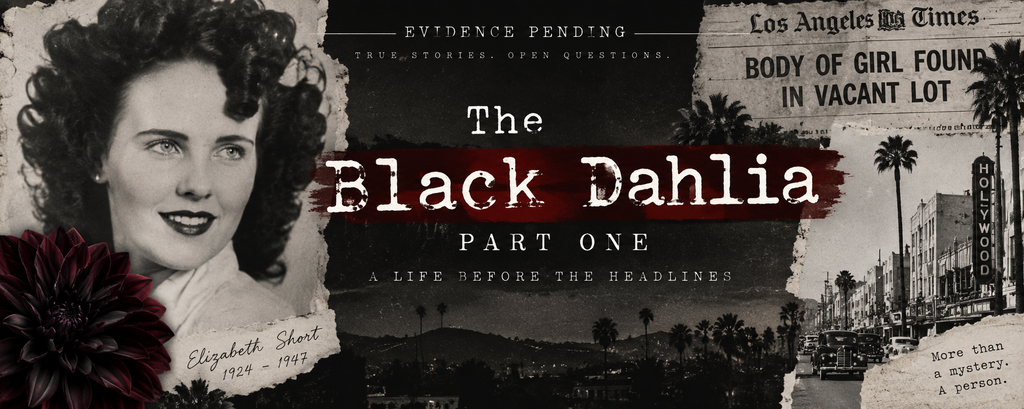
On January 15, 1947, Elizabeth Short became the Black Dahlia.
But that isn’t where her story begins. Nor is it where we will begin.
Long before newspaper headlines turned her into one of America’s most recognizable murder victims, she was Betty—a 22-year-old woman whose life was considerably messier, sadder, and more human than the legend that eventually replaced her.
Elizabeth was beautiful, but her life wasn’t glamorous. She had little money and no permanent home. She moved between hotels, apartments, and the homes of friends and acquaintances. It was said she cared deeply about her appearance even when the rest of her life seemed anything but put together. She had dreams for her future, complicated relationships, and a tendency to tell stories about herself that didn’t always line up with reality.
Elizabeth was also carrying loss.
There had been men in Elizabeth’s life, but one name appears repeatedly when people who knew her talked about love: Matt Gordon, an Army Air Forces pilot who died during World War II. Exactly what their relationship had been would later become another disputed piece of Elizabeth’s story, but her mother believed Gordon was the man her daughter truly loved.
Elizabeth wasn’t a perfect angel.
She didn’t need to be.
She was young. She made questionable choices. She could apparently be difficult to understand. She sometimes depended on other people to get by. And somewhere among the people, places, relationships, and decisions that made up her complicated life, she crossed paths with someone who would take it from her.
Nearly eighty years later, we know what that person did.
We still don’t know who they were.
So before we examine the crime scene photographs, police reports, suspects, anonymous letters, newspaper headlines, and decades of theories, I want to do something the Black Dahlia story has not always done particularly well.
I want you to meet Elizabeth.
Because this isn’t really the story of the Black Dahlia.
It’s the story of Elizabeth Short.
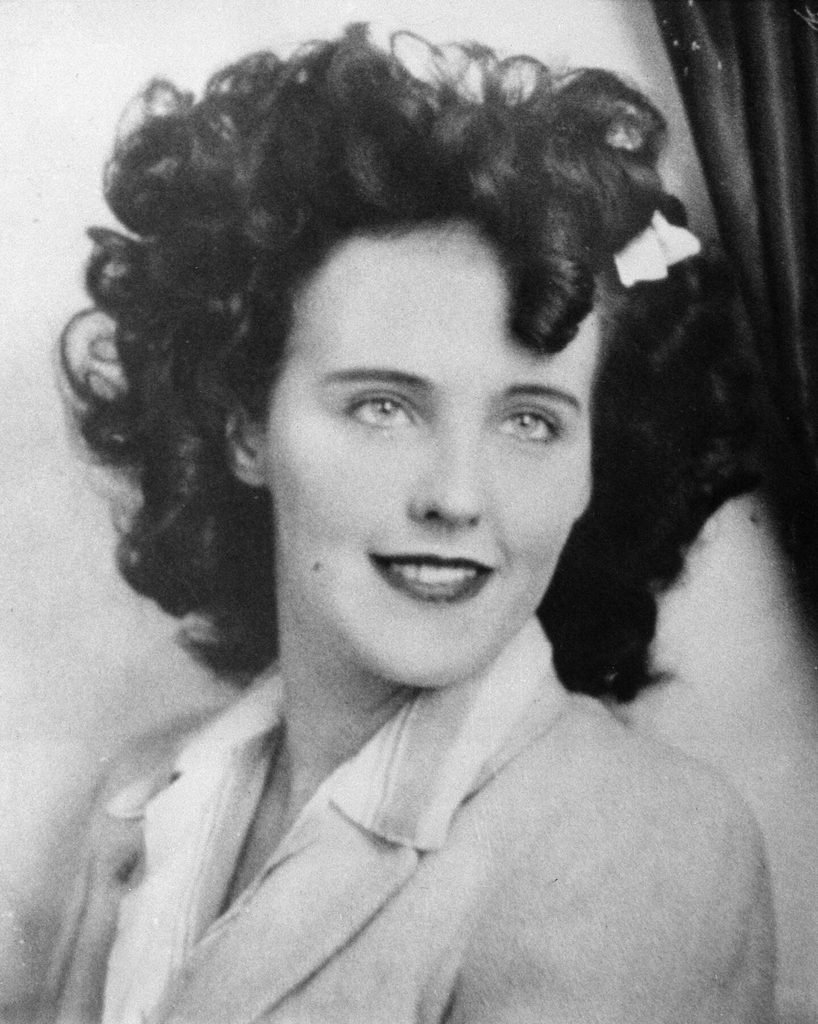
Before There Was the Black Dahlia, There Was Betty
Elizabeth Short was born July 29, 1924, in Hyde Park, Massachusetts, to Cleo and Phoebe Short.
She was the third of five daughters.
Her sisters were Virginia, Dorothea, Elnora, and Muriel, and during Elizabeth’s early childhood, the family settled in Medford, Massachusetts.
To the people who knew her, Elizabeth was often simply Betty.
That’s what I’m going to call her for much of this part of the story.
Because “Elizabeth Short” has become inseparable from a police file, and “the Black Dahlia” has become something even bigger—a character created through newspaper headlines, books, movies, rumors, and decades of speculation.
But Betty was a little girl before she was any of those things.
And her childhood wasn’t particularly easy.
Her Father Disappears
When Betty was still very young, her father left the family.
The story most often repeated is dramatic: Cleo’s car was supposedly found abandoned near a bridge in 1930, leading his family to believe that he had taken his own life.
Years later, they learned he was alive.
He had left them.
There are some questions surrounding the exact details and chronology of that story, so I’m hesitant to present every part of it as settled fact. What is clear is that Cleo was no longer part of the household and Phoebe was left to raise five daughters.
Think about that for a moment.
Five girls.
The Great Depression.
One mother.
Whatever Betty understood about her father’s disappearance at six years old, growing up without him became part of her childhood.
I’m not going to tell you that this explains the woman she eventually became. We can’t crawl inside the mind of a six-year-old girl who lived almost a century ago.
But we also shouldn’t pretend it didn’t happen.
Betty Was a Dreamer
The pieces that survive from Betty’s school years don’t paint a picture of an exceptional student.
Instead, she appears to have been something of a daydreamer.
Later research into her life suggests that her stronger marks weren’t necessarily academic but rather in areas like courtesy and cooperation. She liked movies, and there are accounts of Betty and other girls watching films and later acting out scenes themselves.
It’s tempting, knowing what comes later, to turn that into the beginning of some grand Hollywood obsession.
We don’t need to.
She was a teenage girl who liked movies.
She liked clothes.
She liked imagining things.
She apparently liked the idea that somewhere outside Medford there was a much larger world waiting for her.
That seems ordinary.
And that’s exactly what I like about it.
Her Health Changes Everything
Betty also had health problems.
She suffered from serious respiratory trouble while growing up, described in different sources as asthma, bronchitis, and other lung problems. Eventually, her health interfered with her schooling.
She left high school before graduating.
Doctors reportedly recommended that she spend the cold Massachusetts winters somewhere warmer, and around 1940 Betty began traveling to Florida.
She was only about sixteen.
That detail changed the way I thought about her.
Years later, Betty would frequently be described as a “drifter,” a young woman who moved constantly from one place to another.
But movement had become part of her life long before Hollywood.
At an age when many teenagers were still living entirely inside the world of school and home, Betty was traveling between Massachusetts and Florida.
She worked.
She met people.
Then she came home.
And when winter returned, she left again.
Betty learned young how to pack a bag and go somewhere else.
Florida
The Florida years are something I want to continue researching because they are one of the periods when we see Betty begin to become independent.
She reportedly worked as a waitress while there.
There are also stories about modeling and beauty contests, although those details need better documentation before I’m comfortable presenting them as fact.
What we do know is that Florida offered something Massachusetts couldn’t.
Warm weather helped her health.
And there were people, jobs, nightlife, servicemen, and possibilities beyond the world she’d grown up in.
Then Betty would return home.
For a while, she appeared to have lived a life divided between the two places.
Florida in winter.
Massachusetts when the weather warmed.
And somewhere during those years, her father came back into the picture.
Cleo
Cleo Short was alive.
Eventually, contact was reestablished between father and daughter.
The commonly repeated version of the story is that Cleo first contacted Phoebe seeking forgiveness. Phoebe wanted nothing to do with him, but Betty began corresponding with her father herself.
Again, there are parts of this story I still want to verify against earlier records rather than rely entirely on later retelling.
But we know what happens next.
By late 1942, Cleo was living in California.
And eighteen-year-old Betty decided to go to him.
That decision is often folded into the mythology that Elizabeth Short went west chasing Hollywood.
The reality appears to have been more complicated.
She wasn’t simply running toward a movie studio.
She was an eighteen-year-old girl traveling across the country to live with the father who had disappeared from her childhood.
Whatever Betty hoped that reunion would be, it didn’t last.
California
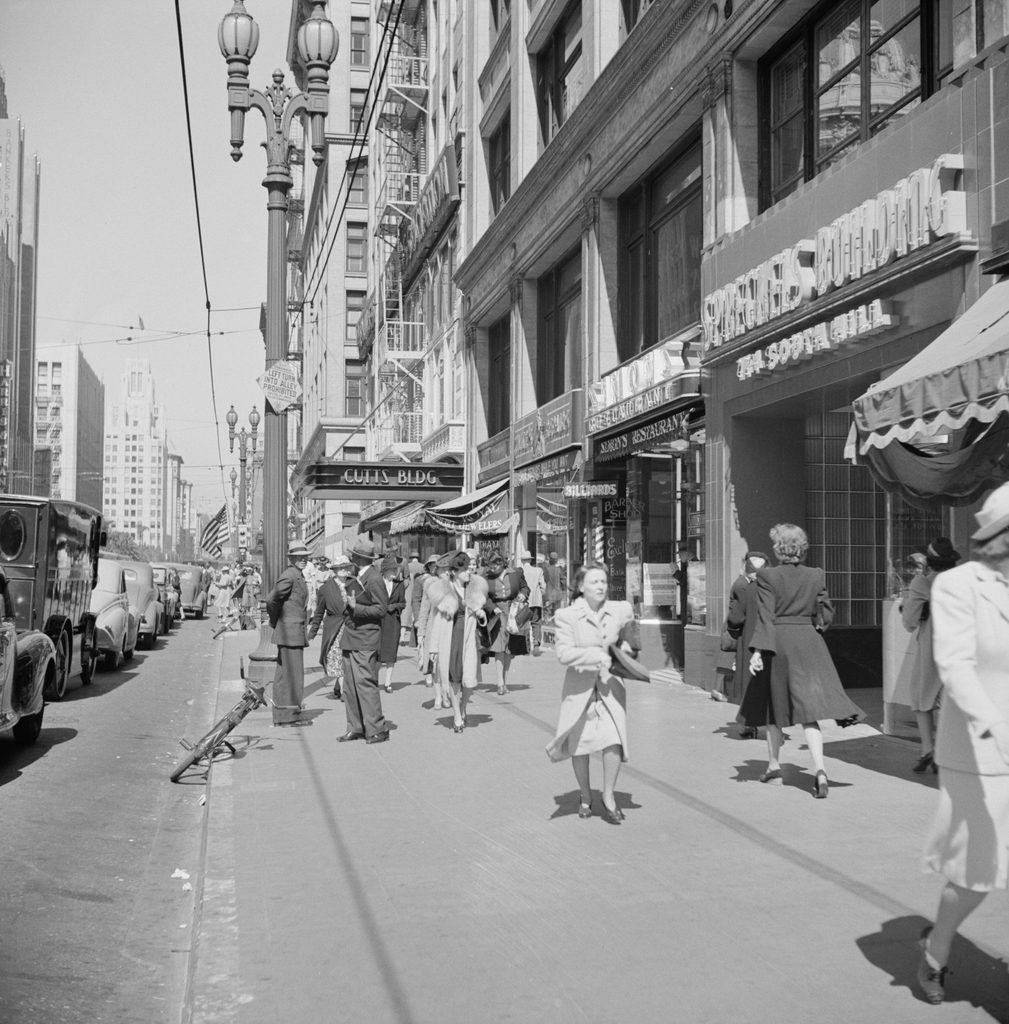
Betty arrived in California in late 1942.
She and Cleo attempted to live together.
They didn’t get along.
Accounts describe arguments about Betty’s behavior and about what Cleo expected from his daughter at home. Before long, the reunion was over.
Once again, Betty had to figure out where she was going next.
In January 1943, she applied for civilian work at Camp Cooke, an Army installation near Lompoc, California.
She was eighteen years old.
She got the job.
And somewhere during that completely ordinary employment process, someone rolled Betty’s fingers across an ink pad.
Her fingerprints were taken as part of her application.
Nobody involved had any reason to think those fingerprints would ever matter again.
At Camp Cooke, Betty worked around young servicemen during the middle of World War II. She even appeared in the base publication as its “Cutie of the Week.”
This was not yet the mysterious woman in black created by later stories.
She was an eighteen-year-old working at an Army camp.
And apparently having some fun.
Betty Gets Arrested
In September 1943, nineteen-year-old Betty got herself into trouble in Santa Barbara.
She was arrested for underage drinking.
There are versions of this story that make the incident sound much wilder than the surviving evidence supports. Researcher Larry Harnisch has pointed out that accounts describing a huge drunken disturbance near Camp Cooke appear to be embellishments. Betty was apparently on a double date and got caught drinking while underage.
That’s it.
It was essentially her entire criminal record as well.
Police photographed her.
They fingerprinted her.
And once again, nobody involved could possibly have understood how important those records would eventually become.
After the incident, Betty returned east.
And Then Came the War
Betty was coming of age during World War II.
Young men were everywhere—and then suddenly they weren’t.
They trained.
They shipped out.
They wrote letters home.
Some came back.
Some didn’t.
Betty knew a number of servicemen during these years.
But one name became different from the others.
Matthew Michael Gordon Jr.
Matt Gordon was an Army Air Forces pilot.
The exact details of Betty and Matt’s relationship have become tangled over the decades. Some accounts say they were engaged. Others question whether a formal engagement ever actually existed.
I’m not interested in forcing their relationship into a label the evidence can’t support.
Because we don’t need to.
There is surviving evidence that Matt Gordon was a real and meaningful part of Betty’s life.
And Betty’s mother would later say that Matt was the man her daughter truly loved.
Then, in August 1945, Matt Gordon died in a plane crash overseas.
Betty was twenty-one years old.
That’s another moment where it would be easy for me to tell you what happened inside her head.
I’m not going to.
I can’t tell you that Matt’s death broke her.
I can’t say it explains the instability that followed.
I can’t tell you that losing him changed the course of her life.
Maybe it did.
Maybe it didn’t.
What I can tell you is that a young man who appears to have mattered deeply to Betty died.
And Betty kept going.
She Always Seemed to Keep Going
The more I learn about Elizabeth Short, the more this pattern stands out to me.
Something changed, and Betty moved.
Her health made Massachusetts winters difficult for her, so she went to Florida.
Her father reappeared, so she went to California.
Living with her father didn’t work out, so she found somewhere else.
She got into trouble in Santa Barbara, and she went back east.
She traveled between Florida and Massachusetts.
She worked.
She met people.
She made friends.
She dated.
She lost people.
And she kept moving.
That doesn’t necessarily mean Betty was running from anything.
Maybe sometimes she was.
Maybe sometimes she was running toward something.
Maybe she was simply twenty-one years old and didn’t know yet where she belonged.
I think we have to allow her that uncertainty.
1946
By 1946, Betty was ready to move again.
This time, she would head west.
She would travel through cities and meet people whose names would eventually fill pages of police reports.
She would stay in hotels, apartments, and spare rooms.
She would spend time in Long Beach and Los Angeles.
She would acquire a strange nickname that she may never even have known people were using.
She would become increasingly broke and increasingly dependent on friends and acquaintances.
But she would also laugh, go out, dress carefully, meet men, make friends, irritate people, tell stories, make plans, and continue trying to figure out what came next.
In other words, she would live.
And that’s where I want to go next.
Not to January 15.
Not yet.
First, I want to spend some time with Betty in 1946.
Because she had less than a year left to live.
But she didn’t know that.
And for now, neither do we.
Until next time, remember: before they were a case, they were a person. Remember their name.