Every case has a story. Every story has evidence.
True crime is rarely as simple as a headline.
Behind every cold case, criminal trial, historical murder, and infamous crime are records, witnesses, evidence, unanswered questions—and, most importantly, real people whose lives were forever changed.
Welcome to Evidence Pending, a true crime blog dedicated to looking beyond the headlines and examining the stories, evidence, history, and questions behind criminal cases.
I’m Meredith, the creator of Evidence Pending. I’m currently working toward my bachelor’s degree in history, and I’ve always been fascinated by research and the stories hidden within historical records. True crime has been another longtime interest of mine, and Evidence Pending brings those two interests together.
My goal isn’t simply to retell crime stories.
I want to research them.
True Crime With an Evidence-First Approach
One of the most fascinating—and frustrating—things about true crime is how quickly fact and speculation can become intertwined.
A detail gets repeated in a newspaper article. Another source repeats it. Years later, it appears in documentaries, podcasts, social media posts, and online discussions until something that began as a rumor can easily become accepted as fact.
Evidence Pending takes a different approach.
Whenever possible, I’ll go back to contemporary newspaper reports, court documents, law-enforcement records, historical archives, interviews, public records, and other credible sources.
That doesn’t mean theories won’t have a place here. Some of the most interesting questions surrounding unsolved crimes involve competing theories.
But a theory will be identified as a theory. An allegation will be identified as an allegation. And a documented fact will be treated as such.
Sometimes the evidence gives us answers.
Sometimes it creates even more questions.
What You’ll Find on Evidence Pending
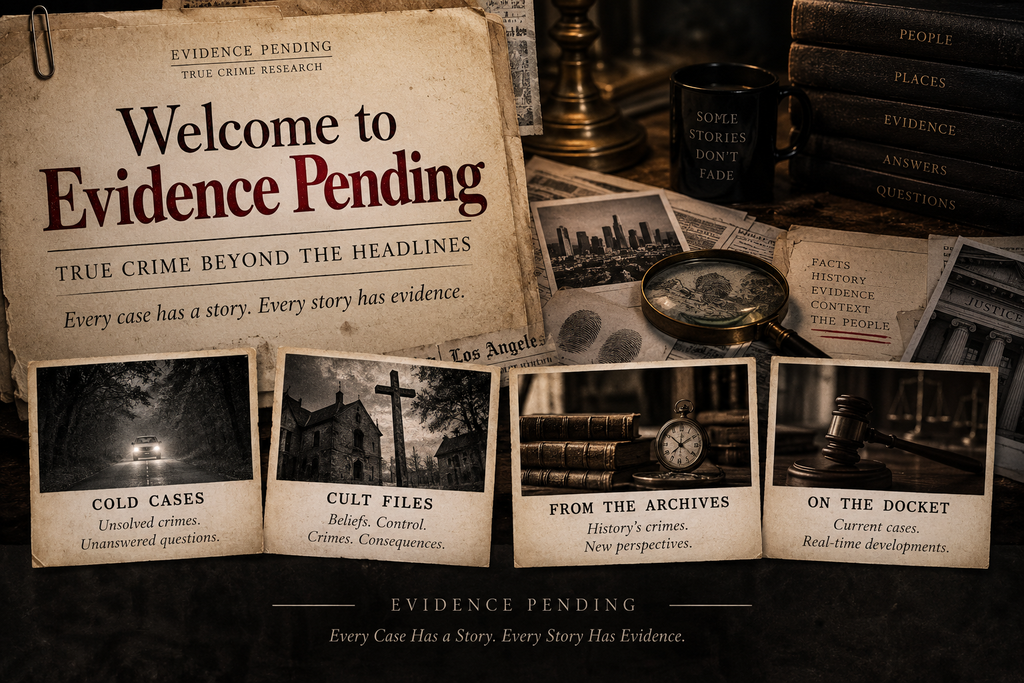
Each week, Evidence Pending will explore true crime through four different types of stories.
Cold Cases
Unsolved murders, disappearances, unidentified victims, reopened investigations, and cases that have gone decades without answers.
We’ll look at what happened, what investigators discovered, where the investigation led, and what questions remain unanswered.
Cult Files
Cults and high-control groups have produced some of the strangest and most disturbing chapters in criminal and social history.
Cult Files will examine their origins, leaders, beliefs, methods of control, victims, investigations, crimes, and aftermath.
The goal isn’t simply to focus on infamous leaders. It’s also about understanding how these groups formed, why people joined them, and what happened to those caught within them.
From the Archives
This is where my love of history and true crime really meet.
From the Archives will revisit historical murders, trials, mysteries, scandals, and crimes through the records left behind.
Rather than looking at the past entirely through a modern lens, we’ll examine what contemporary newspapers, historical documents, court records, and other sources can tell us about what actually happened.
And sometimes we’ll discover that the story history remembers isn’t quite the story the records tell.
On the Docket
True crime isn’t limited to the past.
On the Docket will follow current criminal cases and trials, including important testimony, evidence presented in court, prosecution and defense arguments, verdicts, sentencing, appeals, and major developments.
Current cases require particular care.
An arrest is not a conviction, an allegation is not a proven fact, and everyone accused of a crime is entitled to the presumption of innocence unless and until proven guilty in a court of law.
Evidence Pending will clarify those distinctions.
Remembering the People Behind the Case Files
There’s something else that’s important to me.
These aren’t fictional mysteries.
The names appearing in these stories belong to real people. Victims had families, friends, plans, personalities, and lives that extended far beyond whatever happened to them.
I don’t want Evidence Pending to reduce someone to “the victim in a famous murder.”
Whenever the available records allow it, I want to learn who they were before they became part of a case file.
That doesn’t mean ignoring difficult or disturbing details when they’re necessary to understand a case. It means remembering that true crime carries a responsibility that fictional crime does not.
Case File 001
Our first major journey into the archives takes us to Los Angeles in 1947 and one of the most famous unsolved murders in American history:
The murder of Elizabeth Short.
Most people know her by another name:
The Black Dahlia.
But nearly eight decades of books, movies, theories, suspects, rumors, and sensational headlines have made it increasingly difficult to separate Elizabeth Short from the legend surrounding her.
So we’re going back to the record.
Case File 001: Elizabeth Short — Separating the Black Dahlia Murder From the Myth will examine what we actually know, what became part of the legend, the evidence investigators had, the suspects and theories that followed, and the questions that remain unanswered.
It’s also a fitting place for me to begin. The Black Dahlia was one of the first true-crime cases I ever seriously researched—I wrote a paper on it in high school.
Years later, I’m returning to it with considerably different research skills and a different question.
Not simply:
Who killed Elizabeth Short?
But:
What does the evidence actually tell us?
Welcome to Evidence Pending.
Beyond the headlines. Behind the evidence.